
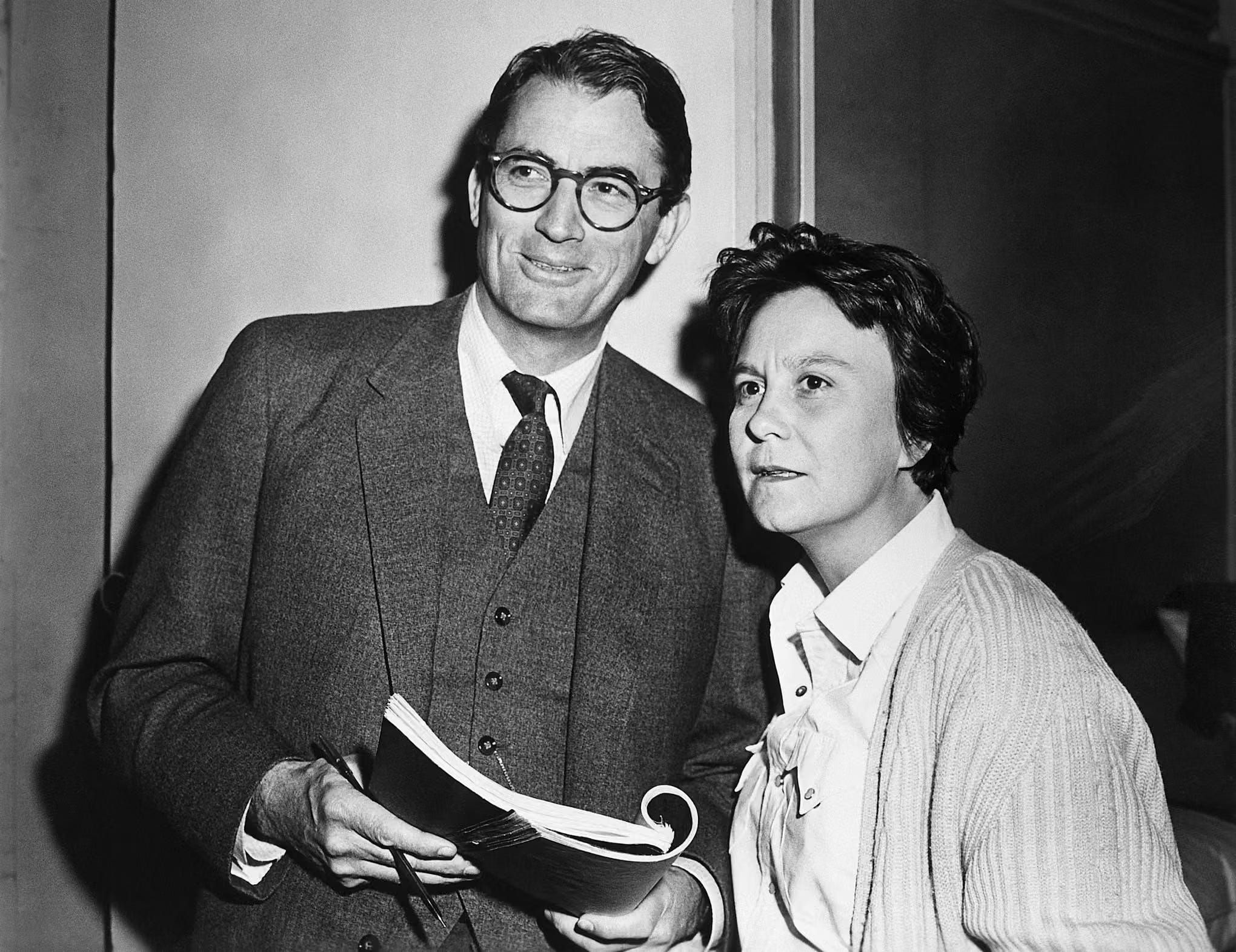
Accidents of history sometimes place otherwise unknown people in historic spotlights. Such was my fate when last August curiosity got the best of me and I found a long-lost manuscript written by one of America’s most beloved authors. The manuscript was titled “Go Set a Watchman,” and its author was Harper Lee.
— Tonja B. Carter, “How I Found the Harper Lee Manuscript,” The Wall Street Journal, July 12, 2015
The literary world has been riveted in recent years by the publication of Go Set a Watchman, Harper Lee’s second novel, and her first since To Kill a Mockingbird was published in 1960.
Watchman, described as both a follow-up to Mockingbird and a draft the original novel grew out of, finds iconic character Atticus Finch 20 years later, now an unreconstructed racist. This change in his character — a significant departure from the Atticus of Mockingbird, who is a beacon of fairness and bravely defends a Black man falsely accused of rape — has disturbed Lee’s readers, many of whom consider her original title their favorite childhood book.
The brouhaha surrounding Watchman, however, may soon seem a minor tremor compared to the earthquake about to rattle the American literary landscape. Spurred on by Lee attorney Tonja Carter’s discovery of Watchman in a forgotten Lord & Taylor box, individuals across the country have rummaged through the nooks, crannies, and sufficiently vague legal documents of American literature, in the process unearthing a trove of previously unknown — and often astonishing — manuscripts.
Among the discoveries:
GATZ & SONS BY F. SCOTT FITZGERALD
An apparent early draft of The Great Gatsby, Gatz & Sons was discovered by a descendant of F. Scott Fitzgerald after she tumbled down a flight of stairs drunk at a party and broke open a hidden wall compartment containing the manuscript.
In this version, Jay Gatsby, resolved that Daisy Buchanan is nothing more than a “high-hat gold digger” who is “off her nuts,” sells his estate, assumes his former name, and returns to North Dakota, where he marries a girl more suited to his background and opens a modestly profitable department store.
THE SCARLET LETTER BY NATHANIEL HAWTHORNE
Scholars who have speculated over Hawthorne’s sexuality will have new material to parse in an early draft of The Scarlet Letter, recently auctioned at Sotheby’s by the author’s descendants.
Although most of Hawthorne’s tale of adultery in Puritan Boston remains the same in this version — which is written in a rare fuchsia-colored ink — there are a few key differences. For instance, almost every sentence ends with the words honey, bitch, or girl (as in, “A pure hand needs no glove to cover it, girl!”), and the Reverend John Wilson operates a sex dungeon in the basement of his church.
INVISIBLE MAN II: VENGEANCE BY RALPH ELLISON
In this sequel to his National Book Award–winning novel about the intellectual, economic, and sociopolitical state of Black Americans at the last mid-century, Ralph Ellison’s narrator emerges out of a manhole from the underground, only to discover a radioactive substance in the sewers has rendered him not just figuratively, but also literally, invisible. Also, he can somehow fly.
In the ensuing hard-boiled caper, the narrator rescues babies from burning buildings, foils bank robberies, and — spoiler alert! — single-handedly saves Manhattan from the Apocalypse.
Rights to the novel were secured by director Michael Bay from some distant relatives of Ellison’s, who swear the 54-page manuscript was definitely written by the renowned novelist.
Invisible Man II: Vengeance will be simultaneously released as a $380 million blockbuster film featuring Will Smith and the voice of James Earl Jones.
CHEETOS, TWIZZLERS, DIET PEPSI BY DAVID FOSTER WALLACE
A searing indictment of American consumer culture, Wallace’s surprise epistolary novel utilizes a variety of forms — Post-it notes, grocery lists, torn envelopes with stuff written on them — to create an elaborately detailed send-up of everything from exasperation with rising cable TV subscription rates and not actually needing more peanut butter because there’s some at the back of the cabinet, to the everyday frustration of forgetting to shut off the bathroom light.
Originally taped together by a guy who found it sitting in the bottom of some rubbish containers in front of Wallace’s house, the Cheetos, Twizzlers, Diet Pepsi manuscript is sure to liven the continuing debate over this brilliant, troubled author.
RECENT HAPPENINGS AT THE HOWARD COUNTY POST OFFICE AND OTHERS BY WILLIAM FAULKNER
Their curiosities piqued by the circumstances of Watchman’s discovery in neighboring Alabama, literary mavens in Oxford, Mississippi — hometown of Nobel laureate William Faulkner — were shocked to discover their own literary lion had left a trove of unpublished works.
And, just like many devotees of Mockingbird, local Faulkner fans have expressed dismay over the content of the uncovered manuscripts.
For reasons that remain unclear, the prolific author, who set most of his stories (among them Absalom, Absalom! and The Sound and the Fury) in the fictional Yoknapatawpha County, Mississippi, appears to have set an equal, and possibly greater, number of tales in the very real Howard County, Iowa.
The stories are largely uneventful, concerned with quotidian matters such as visiting the post office, stopping by the village druggist, and attending a local high school football game.
“It’s baffling. From what I can tell, Faulkner had never even been to Iowa,” said Stephen B. Oates, a Faulkner biographer. “It makes no sense. But then again, you know, he did drink.”
CHARLOTTE’S WEB? BY E.B. WHITE
As it turns out, in author E.B. White’s late-in-life rewrite of his beloved children’s classic, Charlotte’s Web, both Wilbur, the pig, and Charlotte, the spider, are — much like Watchman’s Atticus Finch — unrepentant racists.
The manuscript, found by the children of White’s housekeeper after her death, is a profanity-laden screed against civil rights, interracial marriage, and integration, forcefully advocating for the return of Jim Crow laws.
Vastly expanded, the book features a particularly blue monologue by Templeton, the rat, in which he questions Chief Justice Earl Warren’s sexuality, and a comedic scene where the talkative goose burns dinner at his fundraiser for Alabama Governor George Wallace.
White’s publisher, HarperCollins, has elected to simply add a question mark at the end of the original title, as the author’s preferred title is considered unpublishable, even by modern standards. ♦