
“In this world, there are things you can only do alone, and things you can only do with somebody else. It’s important to combine the two in just the right amount.”
— Haruki Murakami, After Dark
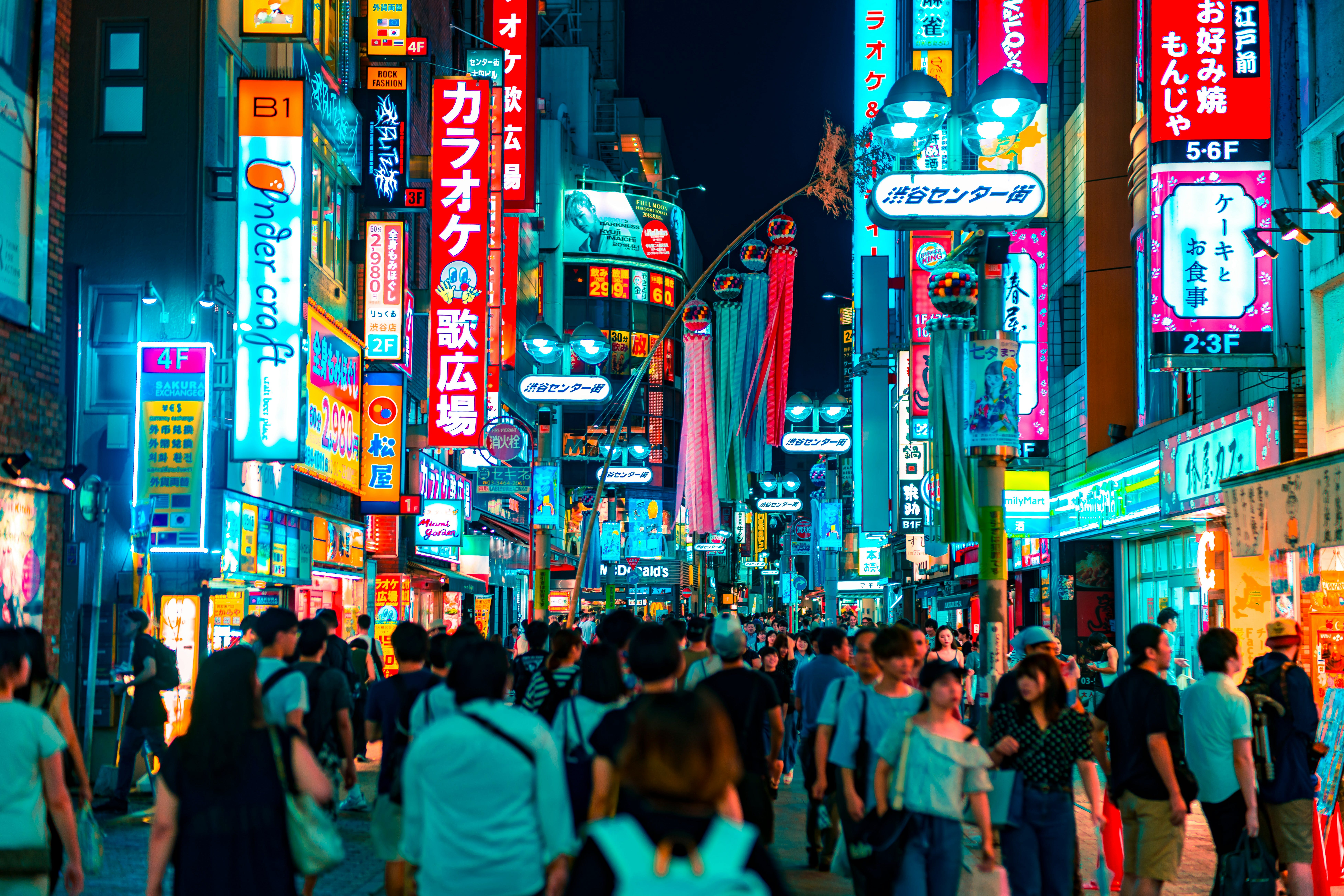
As a city, Tokyo (東京) surprises you. You arrive expecting an urban blob — to be buffeted by vast walls and towers of glass and steel, flashing LED lights, blinking signs advertising businesses in Japanese and bad English, hordes of people rushing at you from every angle.
And you are. But Tokyo’s vastness is much more complex and interesting than that. In person, you are struck by how small the city can be, by its crampedness — the narrow doorways and tight passages, the way the closeness and the height of the skyscrapers can make walking outside, especially at night, feel like walking through an underground tunnel.
Adding to the subterranean vibe, the city’s rolling hills sometimes give you the feeling that you are wandering down an actual rabbit hole, wondering what exciting new vistas you might encounter down the way and around the bend.
Crowded, frenetic pavements give way to exquisitely manicured, placid parks, dotted with cherry trees and koi ponds; banks of vending machines, selling anything you can think of, become office towers, spewing salarymen out into the streets — off to the izakayas (居酒屋), hotel bars, karaoke joints, and pachinko parlors — like herring on a run; alleys of mom-and-pop sushi and ramen shops with signs reading NO ENGLISH eventually lead to huge plazas of American chains, selling deliciously bizarre food items you could never get at the McDonald’s back home.
Yes — just like New York’s hottest club, Tokyo has everything. Everywhere. And it stretches far over the Kantō Plain (関東平野), making it big not only in population (37 million), but also in its sheer size. This can make the city a disorienting place — especially if you don’t speak Japanese. (Like those signs on the izakayas and sushi places suggest, most denizens of Tokyo do not speak English.)
The disorientation this landscape can inflict upon anyone in Tokyo, especially an outsider, makes it the perfect setting for the magical realist, hardboiled detective fiction of one of the city’s most famous (at least internationally) writers — Haruki Murakami (村上春樹).
Murakami, who early on in his life owned a jazz club in Tokyo, turned to writing in his 30s, as he writes about in his memoir What I Talk About When I Talk About Running (走ることについて語るときに僕の語ること). His plots, blending real and surreal events, typically feature loners and those who feel disconnected or alienated from society. His protagonists encounter mysterious strangers and go on otherworldly quests, having out-of-body experiences and meeting surprise after surprise, as they pursue the answers to vexing questions, grapple with existential concerns, fall in love, fuck, and have their hearts broken. The novels often leave us, the reader, on an ambiguous note, with more questions than answers.
Murakami achieves the uncanny voice and disconnected vibe of his novels in a particular way — by writing his stories in English first, then translating them to Japanese. The practice gives his characters a placeless, aphoristic patois, and makes his books perfect reading for backpack-carrying travelers making their way through airport lounges and subway platforms.
♦
When I visited Tokyo fifteen years ago, I was living in Seoul, South Korea, teaching English at a hagwon, and my friend and colleague Jennifer and I were both deep into Murakami phases. I had started with his novel Norwegian Wood (ノルウェイの森), a perfect representative Murakami text, bearing all his hallmarks — the pop art, hardboiled detective fiction plot, Western musical references (the Beatles song), and healthy amounts of explicit sex.
(Everyone at Georgetown had to read Murakami’s book of short stories After the Quake (神の子どもたちはみな踊る) the summer before matriculating. Murakami came to campus to speak about it, and when somebody asked him why he had so much sex in his novels, he replied, “I just like sex.” I loved that answer. Japanese minimalism at its finest.)
Because the hagwon I was working at did not give us very much time off, my Tokyo sojourn was to be a lightning-fast 72 hours. Nevertheless, I was determined to venture down some sort of Murakami-esque rabbit hole, and have my very own Tokyo adventure, during my trip.
I wasn’t traveling solo on this journey, though. And, at the start of the trip, there was a bit of tension with my fellow travelers, my friends Annalise and Arash, about our lodgings. My voluminous emails about booking a hotel had gone unresponded-to for weeks, and so we had all arrived in the city, as tired and blinkered as Bill Murray in the opening scenes of Lost in Translation (2003), without a place to stay yet.
I was left in the exact scenario I had hoped to avoid — the only affordable options left for me, places that my two fancy and precious af friends (a gay Persian man and a pharmaceutical heiress) would never agree to stay at; the only options they liked, four-figure-per-night luxury hotels.
Tired and disoriented at this pre-smartphone time in my life (I wouldn’t get my first iPhone until I arrived back stateside in summer 2010), and wanting to ensure I had somewhere to sleep, I booked myself a bed in the closest budget place I could find: a capsule hotel (カプセルホテル).
Capsule hotels, hostel-like places where you sleep in your very own futuristic pod/coffin, and use communal bathrooms and showers, are pretty common nowadays. You can find so-called luxury versions of them — tricked out with high-speed internet and charging docks for your devices — in cities all over the world. But they were a novelty back then. Media outlets did stories about them, typically with a what-dystopia-are-we-living-in slant. I knew there was no way my friends were going to stay there.
Perfectly, on their end, my friends had chosen to book a five-star hotel on the other side of town. A standoff of sorts began. Our ability to catch up and experience the trip together would have been severely hampered by staying in disparate parts of the city. But, I wasn’t paying $500 a night for my one-third share of a bougie hotel room. And Annalise and Arash definitely were not going to stay in my proletarian pod prison palace.
Without too much unpleasantness, we finally compromised: I would stay at the hotel with them, and pay whatever I felt was fair. For my share, I ended up paying for a few of our activities while we were in Tokyo.
And we ended up seeing quite a lot during our three days there.
On our first day, we checked out the Mori Art Museum (森美術館), located on the 53rd floor of the Roppongi Hills Mori Tower (六本木ヒルズ森タワー). I loved the Mori, which is focused on large-scale, international contemporary art.
The Mori reminded me of Tate Modern in London, with its almost amusement-park-like vibe, where interacting with the exhibits is an expected and integral part of your visit. Also, one of the reasons we all love Japan is for its beautiful design, right? And how weird they like to get with it sometimes? If you agree — then the Mori is for you. The museum was probably my favorite place we visited in the city, overall.
We got lunch at the nearby Gonpachi (権八), the restaurant from the bloodbath scene in Kill Bill: Vol. 1 (2003). Which was probably a mistake. It is not a particularly good restaurant, nor is it particularly interesting in its own right. The most striking thing about the place was the fact that it is so tiny. (Like everything in the movies really is, including the actors.)
And just like everything in Tokyo is, too. The famous Shibuya (渋谷区) crosswalk that Scarlett Johansson emo-walks across with a clear umbrella in Lost in Translation? Tiny!
On the night of our first full day in the city, we did another bit of film tourism, making the necessary pilgrimage to the New York Bar at the Park Hyatt Tokyo (パーク ハイアット 東京) — aka the famous Lost in Translation bar.
We had to go all the way to the other side of Tokyo, where there is not much else to do, and which necessitates an expensive taxi ride to get there, but I am still glad we went. I have written about my love of Lost in Translation many times. It was part of the reason I moved to Asia to begin with.
I ordered a Suntory (サントリー) whiskey, and Arash took a great photo of me, alone at the bar, sipping my drink, looking contemplative, like Bill Murray in the movie. I wore my nice suit and everything. I have to track down a copy of that (and many other) photos from over the years.
The most memorable thing about the bar? Its tininess!
Unfortunately for future travelers, the Park Hyatt Tokyo is currently closed for renovations.
For relaxing times, try the Four Seasons?
♦
On our second day in the city, the three of us ventured to Yoyogi Park (代々木公園), located in Shibuya, near Harajuku Station (原宿駅). The busy park was radiant that day, with cherry blossoms blowing about like confetti.
While in the park, we visited the Meiji Shrine (明治神宮), a Shintō (神道) shrine dedicated to the deified spirits of Emperor Meiji and his consort, Empress Shōken, where tourists and visitors are encouraged to leave their wishes. In an early nod to MAGA, some New York–based family, the Fiorellos, had left a virulently xenophobic, anti-migrant message, tied to the bridge with a beautiful, hateful bow.
Nearby in the park, Annalise, Arash and I participated in a private ancient green tea ceremony, known as chanoyu (茶の湯). The three of us squeezed into a tiny wooden tea house, or chashitsu (茶室), where, while we sat cross-legged on tatami mats (畳), a woman in traditional dress explained to us the historical and cultural significance of the tea ceremony, and explained the role it plays in Japanese life today.
The green tea we drank was strong, almost like matcha. I have to say — the tea ceremony was beautiful, and I am okay with tea, but green tea has never been my thing. I just cannot with the taste. Which kinda sucks, because it is so healthy for you. But even repeated attempts to train my palate and acquire a taste for it over the years have failed.
We also did some shopping in Ginza (銀座), where we got a special tour of the Chrome Hearts store, as Annalise was close with one of the owners and wanted to say hello.
♦
I knew that the evening of our second full day in the city was my best chance to have an adventure. And I doubted that adventure would involve my compatriots, Annalise and Arash, who had been low-key, early-to-bed presences since we had arrived.
And, in fact, that night Arash and Annalise decided they wanted to eat dinner at the five-star Italian restaurant at our hotel, which I decidedly did not want to do. So, I used that as my excuse to take off on my own, and ended up at a small, informal tonkatsu (豚カツ) place. Tonkatsu is breaded and fried pork, and it comes with a very delicious Japanese-style barbecue sauce called katsu sauce (とんかつソース).
As I downed Asahi Super Dry (スーパードライ) beers and began the opening stages of my lifelong love affair with tonkatsu, I got a text from Arash. Being gay as well, he was a bit more game for a bit of nightlife than Annalise. So, he joined me at an LP bar near the tonkatsu place, and we drank a few cocktails in its smoky, dimly lit, wood-paneled environs, as American soft rock and Japanese surf rock spun, and we pored over the gay bar listings I had printed out and brought with me.
I was not sure what kind of adventure I was up for yet. But, a gay bar seemed like a good place to start.
For a city of its population size, and as cosmopolitan as it otherwise is, Tokyo has a surprisingly small number of gay bars. Most of them are clustered in area two of Shinjuku (新宿区), a ward of the city known for its restaurants, red-light district, shanty-style bars and clubs, and gayborhood, which is colloquially referred to as Ni-chōme (新宿二丁目).
Arash and I were not looking for some wild club night, considering we had done a full day of sightseeing, and had a full day of it ahead of us the next day. So, we were hoping to find somewhere vibrating at around the same level as the LP bar — somewhere we could chill, chat and people-watch. Reserving our (profound) judgment over its name, we settled on the nearby Arty Farty (アーティーファーティー).
Arty Farty, located in Shinjuku, is pretty much your standard gay bar, with banquettes, a dance floor, generously poured, disgusting well drinks, and Top 40 playing way too loud. Arash and I arrived just as the salaryman (サラリーマン) crowd was popping in after work, and we settled at a banquette in the back with a good scope on the rest of the place.
As we were sipping our cocktails and checking out the crowd, we soon noticed that a guy was looking at me. No, staring at me. No — gazing at me. Like I was a comet flying through the cosmos, or a Greek god brought down to earth. The guy, cute but nothing special, was dressed like he had just gotten off a shift as a line cook at an izakaya, and young-looking, around 19 or 20 or so. I was only a year or two older than him at the time, and I look pretty young myself, even now, but I felt older looking at him.
After catching my glance, he came over to us, wordlessly took my hand, and began gazing into my eyes intensely. His eyes were opened really wide, like he had traveled to Tibet and walked all the way up that insane mountain in order to speak to the Dalai Lama. The man, who later introduced himself (via an electronic translator) as Akari (あかり), held my hand in his hands, as though he was waiting to receive great wisdom from me, but said nothing — only peering into my soul with those eyes, so wide and intent.
A few minutes passed, and still Akari had said almost nothing to me (and literally nothing in English). Yet, his eyes and his body language communicated the very clear message of: FOLLOW ME. And so, I decided to oblige.
Why did I decide to follow Akari late at night, in a strange city, with zero information? The kids these days have a great term for the answer, the ethos that has powered me throughout much of my life — doing it for the plot. While I now subscribe to the Danny Glover line “I’m too old for this shit!”, back then, I wanted a great story out of Tokyo — and Akari was my rabbit hole.
Winking goodbye to Arash, I followed Akari to the Tokyo Metro (東京メトロ), where we boarded a train headed to God-knows-where. As we zipped further and further away from our station of origin, cramming into the car as more and more passengers filed in at each station, I began to wonder how the fuck I was going to get back to my hotel. Akari, for his part, was silent the entire ride.
After almost an hour, we arrived at our stop, and Akari guided me — by hand — to our ultimate destination, which was (perhaps predictably) a love hotel (ラブホテル).
Akari was clearly enamored of me. And, when he initially took my hand, I figured there was a decent chance he wanted to go to a love hotel with me. It was a request I got quite often.
But, I have to admit, I was a bit disappointed in his choice, as a mere trip to a love hotel did not strike me as a particularly inventive or noteworthy adventure to go on.
My thoughts on this changed immediately, however, when we approached the hotel and walked up to the speaker you shouted into to reserve a room. That was when Akari took the money to pay from me and, placing our order, began speaking into the intercom in the most high-pitched woman’s voice you have ever heard — like a fuckin’ Japanese Mrs. Doubtfire.
The voice came out of nowhere, and deeply amused (and confused) me. I understood the move as Akari being nervous about our same-sex situation — he wanted to make the attendant think he was a woman, so he would not know that we were about to go in and do a bunch of gay stuff together. This made sense, as Japan’s record on gay rights and acceptance of homosexuality is spotty, even today.
But, there were also cameras everywhere, so what the attendant was in fact seeing and hearing was two dudes, one of them frantically screaming, like an elderly woman at 3 a.m., that they needed a room. Admittedly, it could have been just me, but that struck me as an incredibly faggoty display.
Nevertheless, I was grateful to Akari for furthering the plot and giving me that little nugget. And, as it turned out, the attendant was far more interested in his manga (漫画) than in enforcing traditional values, waving us in with zero fanfare.
When we entered our room, we quickly discovered that we had been given the Peter Pan suite, with pukey yellow walls, covered in off-brand Disney drawings of scenes of Peter, Wendy, Tinker Bell, and Captain Hook. It brought me back to my childhood bunkroom at my grandparents’ lake house, where my twin bed had a Peter Pan–themed comforter.
The room even came with an en suite Jacuzzi, located in a bathroom with overhead fluorescent lighting that flickered on and off, giving off a slight the-shower-from-Psycho vibe. There was not much lovely about this love hotel, and it certainly did not put one in the mood.
Fortunately, it did not seem like Akari had much interest in lovemaking, anyway. We definitely made out for a while. But, the room was also filled with video games and vending machines (they really are ubiquitous there), selling things like condoms and lube and premade seafood sandwiches, and after I gave him some yen to start some gameplay and grab some snacks, Akari was perfectly okay to jam on his own. Which was fine with me, wanting, at 4 a.m., nothing more than to go to sleep.
When I awoke a few hours later, surprisingly refreshed, the mysterious Akari had departed. He had left behind his wristband for me, and a note with a giant heart drawn on it. Aside from the haunting memory of the sound of the fluorescent lights buzzing over that Jacuzzi, the note would be my only souvenir from the evening.
♦
When I stay at nice hotels on vacation and they have a good free breakfast, I make a habit of getting back in time to enjoy it, even if I have been off fucking somebody the night before. And, I did the same thing on this trip. Do not ask me how, but I managed to find my way back to our hotel, navigating the jumble of colors and lines and swoops and swirls that is the map of the Tokyo Metro, without a smartphone or guide, or the ability to speak or read Japanese. I was pretty pleased with myself, on that score.
Splashing some water on my face to properly wake up, I soon found Arash and Annalise, grinning at me, from across the breakfast room, sat down, and began to tell them all about my adventure.
♦
Every year, about a dozen Japanese tourists become afflicted with Paris Syndrome (パリ症候群), a psychological condition caused by extreme disillusionment and disappointment when visiting Paris. The stinky reality of the city does not live up to their romantic expectations, and a severe form of culture shock results, leading to symptoms such as delusion, hallucinations, hostility, derealization, depersonalization, tachycardia, and vomiting.
Paris, je t’aime.
I cannot claim to have experienced a Tokyo version of this syndrome. While Tokyo certainly surprised me again and again, each rabbit hole only made me more excited and curious to venture down another.
On our last morning in the city together — before I was due to fly back to Seoul and work — my friends and I got up early, to see the morning catch at the Tsukiji Fish Market (築地市場), mother of the world’s sushi. (Nothing snaps you back to the impending reality of work like the pungent smell of fish at 4 o’clock in the morning.)
After hugs and kisses and speculating on how the Fiorellos’ trip was going, I bid farewell to Arash and Annalise, who were on a longer journey, and bound for Kyoto (京都). Alone for a bit, I spent the rest of my yen at a pachinko parlor, and bought some souvenirs.
And ate some tonkatsu. Of all the things I encountered on my magical mystery tour, I think I loved it the most of all. (No offense, Akari.)
SAYONARA (さようなら)! ♦